400-810-0069转1276
氮化硅(Si?N?)是一种合成非氧化物陶瓷,自1989年起被研究作为生物医学材料。其在骨重建中的应用潜力源于优异的力学性能、微结构特征及细胞毒性表现,已在脊柱和颌面外科中取得初步积极结果。目前临床常用的骨植入材料(钛合金、PEEK、氧化铝)各有不足——钛合金硬度高但耐磨性及生物活性有限,PEEK力学性能偏低,氧化铝韧性较差。Si?N?虽性能突出,但存在硬度极高、加工困难、定制成本高、制备周期长、复杂形状产品难以成型等问题。3D打印(尤其是熔融沉积成型)可实现个性化、快速、经济的复杂结构成型,但此前关于致密Si?N?陶瓷的3D打印研究报道很少,且打印件的致密度和性能尚待提升。
研究目的:利用粉末挤出3D打印结合气压烧结(GPS)制备致密Si?N?陶瓷,系统研究其力学性能、生物相容性及抗菌活性,并与钛合金、Al?O?、PEEK进行对比,以验证其作为骨替代材料的可行性和优越性。
衡阳凯新特种新材料有限公司、马来西亚大学和中南大学研究团队,采用粉末挤出3D打印技术实现定制成型,并通过气体压力烧结制备出致密的氮化硅陶瓷材料,同时对其力学性能和生物活性进行了研究。首次系统性公开了粉末挤出3D打印致密Si?N?陶瓷的完整制备工艺(含脱脂和气压烧结参数)。为骨科、脊柱、颌面等个性化植入体提供了兼具高性能、可定制、快速成型的解决方案,具有明确的临床转化潜力。相关成果以《Mechanical properties and biological activity of 3D printed silicon nitride materials》为题发表于国际知名期刊《Ceramics International》上。
论文摘要
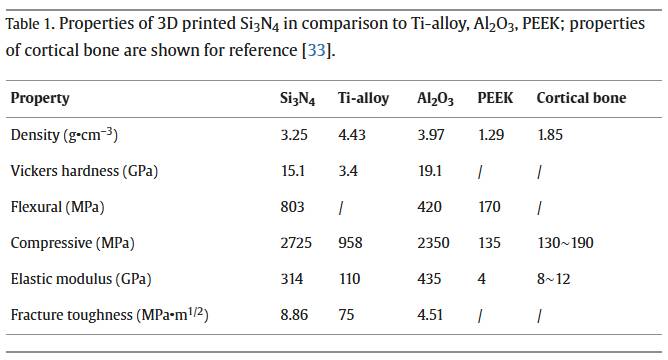
氮化硅(nitride silicon)是一种极具前景的生物医学材料。定制化与可靠性要求是实现氮化硅材料广泛应用的前提条件之一。本研究粉末挤出打印(PEP)技术实现定制成型,并通过气体压力烧结制备出致密的氮化硅陶瓷材料,同时对其力学性能和生物活性进行了研究。与钛合金、氧化铝及PEEK相比,3D打印氮化硅材料在力学性能方面具有显著优势:弯曲强度达803MPa,断裂韧性为8.86MPa·m?/?,维氏硬度为15.1GPa,压缩强度高达2725MPa。此外,氮化硅比其他生物医学材料具有更稳定且优异的生物相容性,在抗菌性能方面表现突出,抗菌率达94.6%。在氮化硅材料表面,细胞呈现良好的形态结构、正常的迁移行为,并更有利于细胞铺展、贴附及交联。研究表明,粉末挤出3D打印方法的熔融沉积填充特性、3D打印氮化硅材料的晶体定向生长微观结构特征以及硅、氮元素的协同作用是实现这些优势的主要原因。
研究亮点
本研究成功采用FDM(即粉末挤出3D打印)结合气压烧结制备了高致密Si?N?陶瓷,系统验证了其作为骨替代材料的综合性能。3D打印Si?N?在弯曲强度、断裂韧性、硬度和压缩强度上均显著优于钛合金、Al?O?和PEEK,同时表现出优异的细胞相容性和强抗菌能力。其优势源于打印工艺带来的β-Si?N?晶粒定向排列微结构,以及Si、N元素固有的生物活性。研究为Si?N?生物陶瓷的个性化、可靠化临床应用提供了可行的制备方案,有望改善患者的临床效果和生活质量。其核心创新亮点如下:
性能突破:3D打印Si?N?的弯曲强度和断裂韧性达到目前生物陶瓷领域的领先水平,远超氧化铝和PEEK。
微结构调控:揭示了PEP打印“挤压-铺展-凝固”过程诱导β-Si?N?晶粒沿打印方向定向生长的机制,该取向结构同时增强了力学性能和生物活性(增加接触面积)。
全面对比:与钛合金、Al?O?、PEEK及皮质骨进行多维度性能对标,数据充分,说服力强。
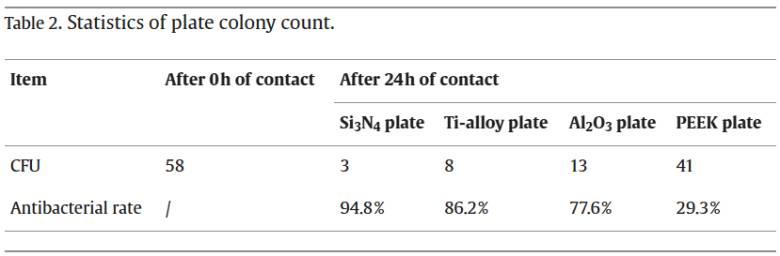
生物学双重优势:同时实现高抗菌率(94.8%)和优异的成骨细胞粘附、增殖能力,克服了传统生物材料“力学-生物活性”难以兼得的矛盾。
图片解析
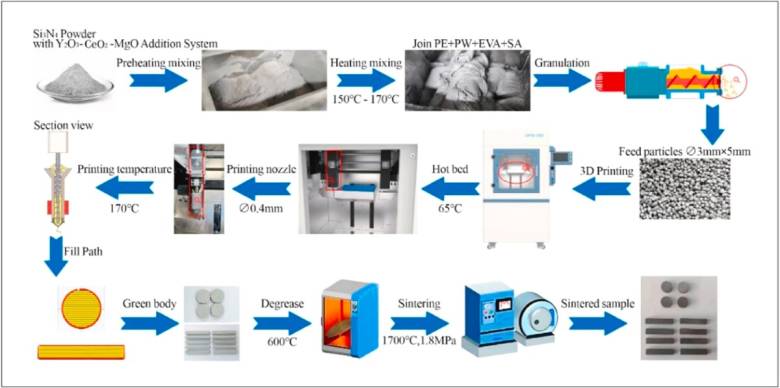
Fig. 1. Preparation process of 3D printed Si3N4 materials.
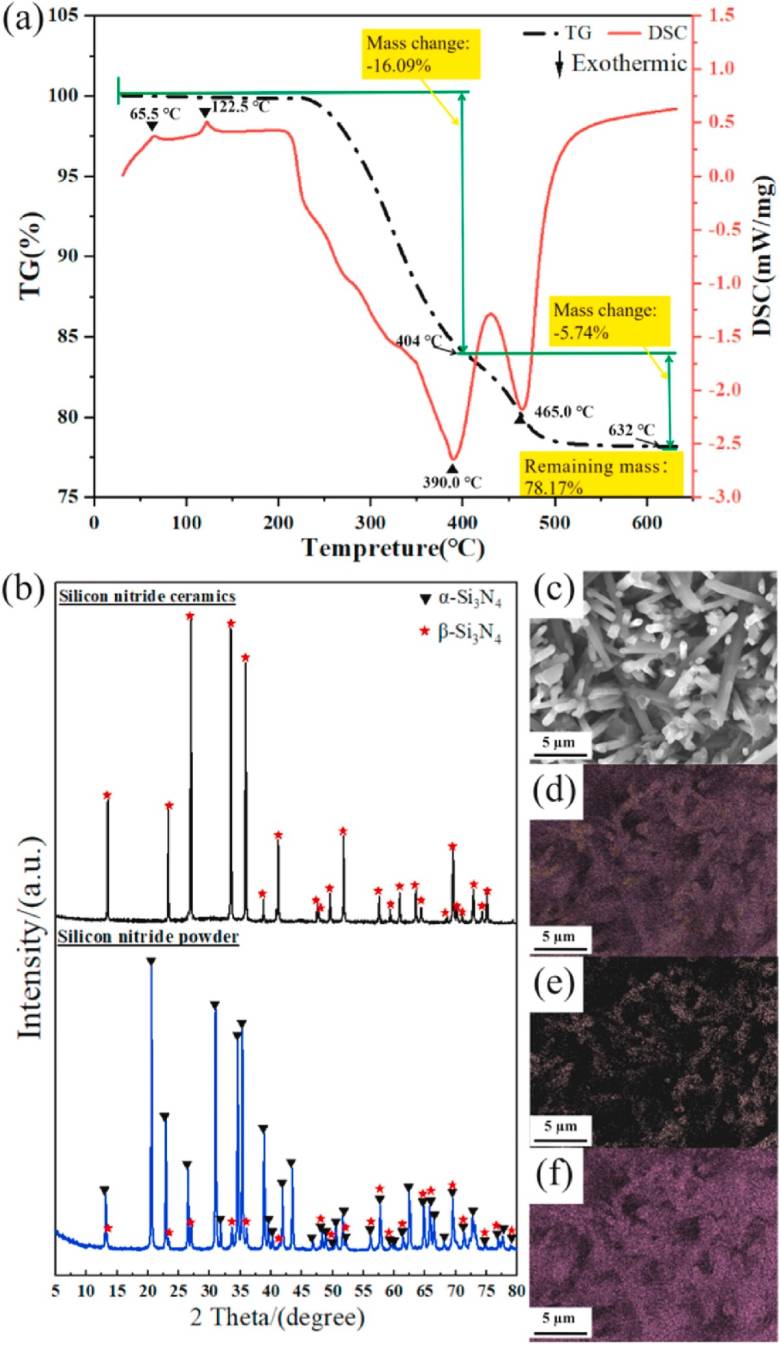
Fig. 2. (a) The TG-DSC curve of 3D printed Si3N4 body; (b) XRD Pattern of Si3N4 raw powder, and sintered 3D printed Si3N4 ceramic, and all peaks correspond to those of a reference Si3N4 (JCPDS 33–1160). Morphological map and corresponding element distribution map of 3D printed Si3N4 surface in FE-SEM mode: (c) Original appearance; (d) Merge; (e) Silicon; (f) Nitrogen. (For interpretation of the references to color in this figure legend, the reader is referred to the Web version of this article.)
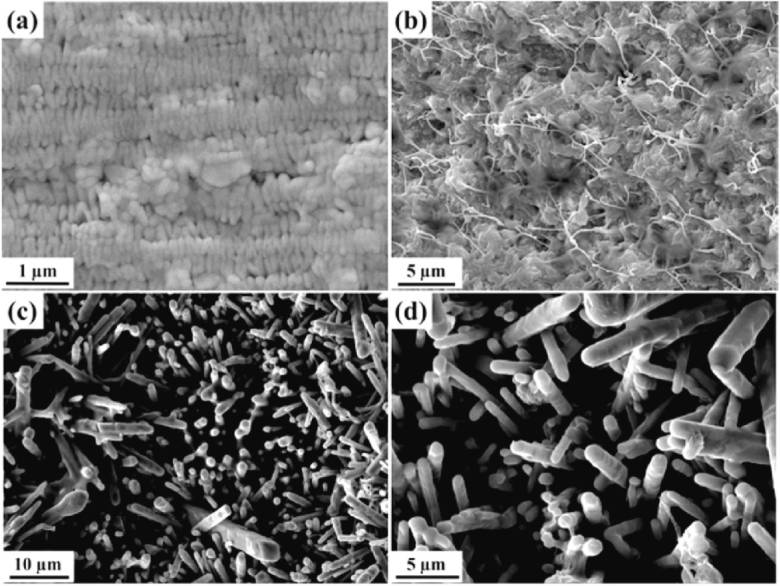
Fig. 3. The morphology of Si3N4 preforms formed by 3D printing: (a) The surface morphology of the billet shows a regular arrangement of powder particles in the printing direction; (b) Cross-section morphology of the billet, distribution and spreading of a small amount of Si3N4 whisker fibrous powder between printed layers in the powder. SEM morphology images of 3D printed Si3N4 material surface at different magnifications: (c) 4.0 kx; (d) 10.0 kx.
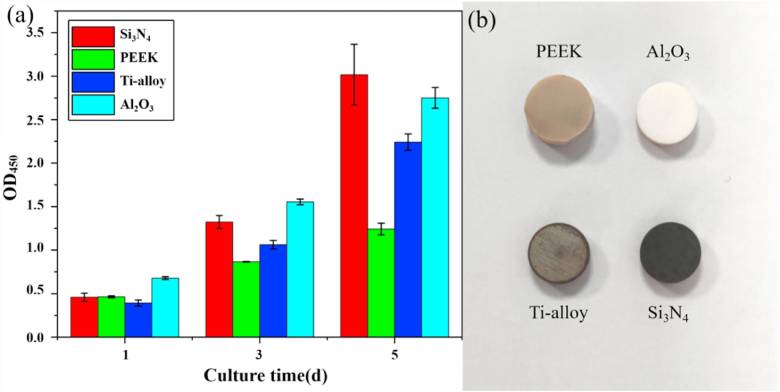
Fig. 4. (a) The growth of cells in different materials at different time; (b) Photos of different material test samples.
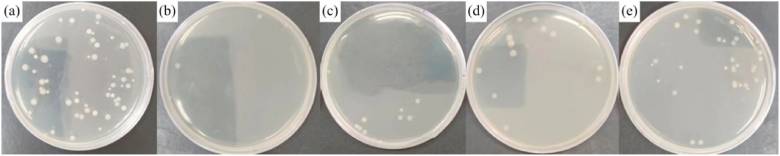
Fig. 5. Cultivation of Escherichia coli growth on the surface of material samples: (a) Materials contact for 0 h control group; (b) 3D printed Si3N4 contact for 24 h experimental group; (c) Ti-alloy contact for 24 h control group; (d) Al2O3 contact for 24 h control group; (e) PEEK contact for 24 h control group.
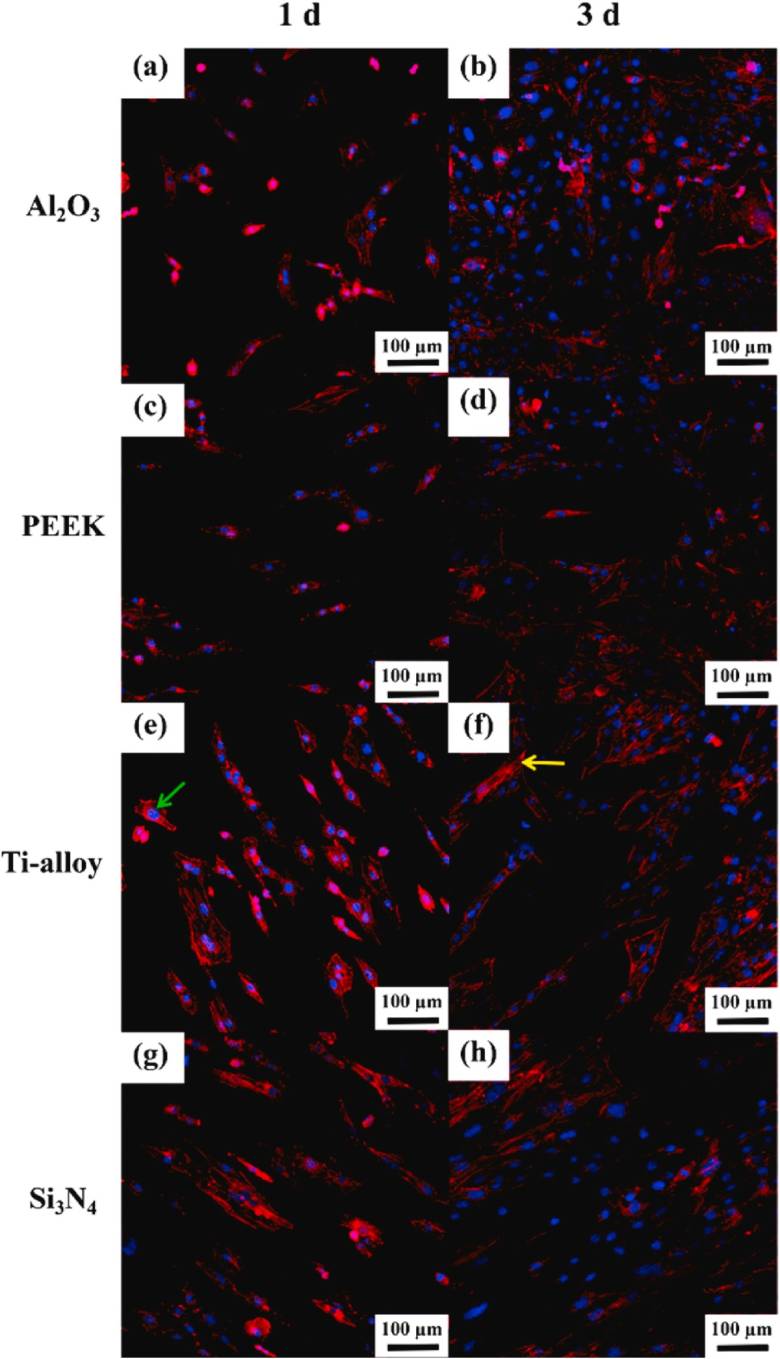
Fig. 6. CLSM images of cell morphology and spreading on 3D printed Si3N4, Ti-alloy, Al2O3, and PEEK samples under 1 day and 3 days cultivation time. Red represents actin filament (Yellow arrow), Blue represents the nucleus (Green arrow): (a) and (b) Al2O3; (c) and (d) PEEK; (e) and (f) Ti-alloy; (g) and (h) Si3N4. (For interpretation of the references to color in this figure legend, the reader is referred to the Web version of this article.)
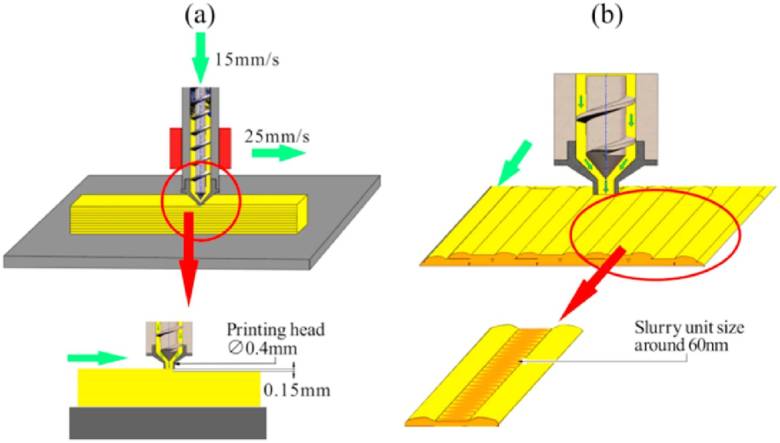
Fig. 7. Schematic diagram of 3D printed Si3N4 material: (a) The combination of Φ0.4 mm printing head and a 0.15 mm printing height generates a force that compresses the slurry downwards; (b) Under the combined effect of the extrusion rate of the printing slurry and the parallel movement rate of the printing head, a continuous and regular arrangement of the slurry with a size of around 60 nm is achieved in its printing direction.
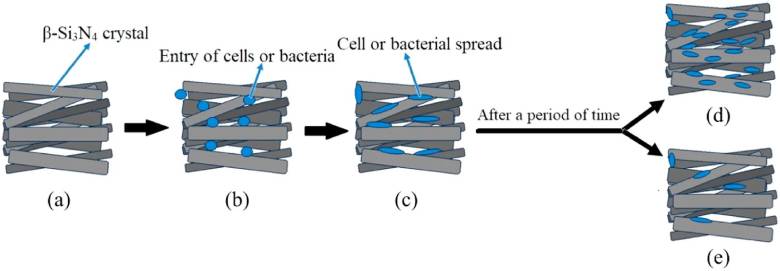
Fig. 8. Mechanism and process schematic diagram of the effect of micro crystal morphology of 3D printed Si3N4 material on its biological activity(a) 3D printed sintered silicon nitride β-Si3N4 crystal; (b) Cells or bacteria enter the surface of the material and begin to come into contact with the material; (c) Cells or bacteria along the surface of the material β-Si3N4 crystal is spread and migrated, significantly increasing the contact area with 3D printed Si3N4 materials; (d) After a period of time, with a significant increase in contact area and the effect of Si and N elements, cells proliferated extensively on the surface and interior of 3D printed Si3N4 materials; (e) After a period of time, with a significant increase in contact area and the effect of Si and N elements, bacteria are significantly inhibited on the surface and interior of 3D printed Si3N4 materials, and the number decreases sharply. (For interpretation of the references to color in this figure legend, the reader is referred to the Web version of this article.)
文章信息:Xiaofeng Zeng, Coswald Stephen Sipaut, Noor Maizura Ismail, Yuandong Liu, Yan yan Farm, Jiayu He. Mechanical properties and biological activity of 3D printed silicon nitride materials. Ceramics International 50 (2024) 16704–16713.
总结与启示
总结:本研究采用粉末挤出3D打印-气压烧结路线,制备出弯曲强度803MPa、断裂韧性8.86MPa·m?/?、抗菌率94.8%的氮化硅陶瓷,证实“低温成型-高温致密化”间接3D打印工艺在高端生物陶瓷领域的可行性,并揭示挤出打印诱导β-Si?N?晶粒定向生长的增强机制。不仅为氮化硅生物陶瓷的临床应用提供了坚实的实验依据,更从学术层面验证了“3D打印+粉末冶金”技术路线在高端陶瓷制备中的巨大潜力。
启示:该研究有力验证了升华三维PEP技术路线的战略价值,为氮化硅医疗植入体的个性化制造提供了工艺范本。晶粒取向与打印参数的关联,提示可主动调控微结构以优化性能。升华三维应加速专用材料体系、工艺参数包及行业标准建设,推动PEP技术在骨科植入等医疗场景的产业化落地。
来源声明:来自《Ceramics International》学术期刊,经升华三维市场部综合整理采编,仅供分享交流。